
Fwd: Museums – Call for Submissions 2025
GUIDE TO: { }
Are you surviving the colonial institutions in place? Are you seeking liberation? Are you boycotting companies that support union busting and genocide? Are you uncomfortable in museums? What is your guide to navigating museums and museum-adjacent spaces? The 2025 Fwd: Museums publication is calling for submissions and is welcoming artwork, resources, interviews, reviews, poetry, and other works on topics related to surviving and navigating cultural institutions.
At Fwd: Museums, we seek to create an alternative space for museum workers, artists, and writers to find shelter and to speak up against the racist and colonial museum culture that currently exists. For its 10th issue, Fwd: Museums is creating a guide for museum victims to explore a variety of issues within museum positions such as “Guide To {Visitor Experience}” or “Guide To {Conservation & Archives}.” The publication aims to develop a helpful resource for everyone to navigate the museum’s colonial practices. Expose, name, and take apart museum violence and share your guide to surviving in these spaces.
Fwd: Museums seeks candid experiences and stories, therefore, submissions will have the option of being published anonymously.
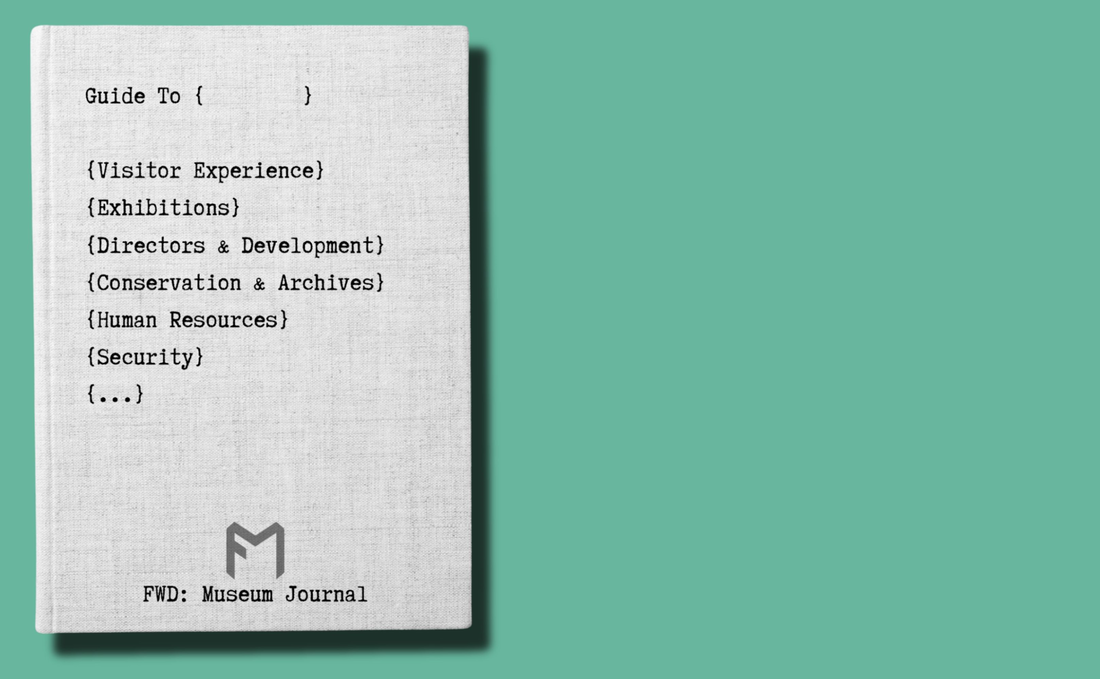
Guide To { }
{Visitor Experience}
{Exhibitions}
{Directors & Development}
{Conservation & Archives}
{Human Resources}
{Security}
{...}
Guide To {Visitor Experience}
As a visitor and/or as someone working for visitor services, what does the museum look like to you? What is your guide to dealing with admissions and visitor experience, specifically turning people away who cannot afford admissions?
Guide To {Exhibitions}
How do you contribute to the development of exhibitions without causing harm? Can exhibitions be a place of resistance or are they inherently colonial? What are some histories of harm that impact your engagement and curatorial practice?
Guide To {Directors & Development}
Should museum hierarchy be necessary? How can those in positions of power uplift others around them? How can directors and development teams place community care at the center of their work rather than issues around funding?
Guide To {Conservation & Archives}
How can museums implement non-colonial conservation? As a backbone of the museum, how can archival spaces be more accessible?
Guide To {Human Resources}
Can museums create checks and balances rooted in true justice? Does HR fulfill its role to protect the workers? How do you navigate HR’s loyalty to museum hierarchy and positions? How can we stop HR from maintaining hierarchy?
Guide To {Security}
Who is security in museums for? What does security keep safe? Thinking of museum spaces with anti-Black surveillance and policing/tailing in institutions while security often consists of Black and POC individuals, what purpose does that serve? How can they be visible and celebrated as members of the institution?
Guide To {...}
Museums are not knowledge keepers, you are! Submissions do not need to fall into these categories neatly. What is your unique guide to surviving in these spaces? If you could wave a magic wand, what would you change?
Deadline: January 5th, 2025 by 11:59 (CT)
Submit Art and Texts Here
Questions? Email us: [email protected]
For Updates Follow Us On
Instagram: @fwd_museums
TikTok: @fwdmuseums
Produced and edited by the University of Illinois at Chicago Museum and Exhibition Studies graduate students and published by Chicago-based, Bridge Books, Fwd: Museums strives to create a space for challenging, critiquing, and providing alternative modes of thinking and production within and outside of museums.
Fwd: Museums invites academic articles, artwork, essays, exhibition/book reviews, creative writing, interviews, poetry, love letters, and other experimental forms to analyze, critique, and make space for new thinking about museums and exhibitions. All submissions should follow the guidelines and relate to the journal’s mission statement. We strongly encourage book and exhibition reviews on multiple topics, but require all other submissions to connect to the tenth issue’s theme, “Guide To: { } ”
Guidelines
Written submissions (other than poetry and more artistic submissions) should be between 1,000 and 2,500 words and use Chicago Manual of Style formatting and citations, in a DOCX file. Broadly accessible language that a large audience can understand is preferred.
All images should be sent as separate files (not embedded in text) at 300+ dpi in tiff format. Note in-text where images should be inserted and include credit, caption, date of execution, materials used, and dimensions, as appropriate.
A Note on Reviews
Reviews need not directly engage an issue’s theme but should relate to the journal’s mission statement. We welcome long-form museum, exhibition, film, and book reviews with a point of view and connections to social, historical, political, and other contexts. Check our Instagram for books available for review.
Who Should Submit?
Anyone! You! Students, faculty, scholars, museum employees, artists and art handlers, volunteers, part-timers, activists, and other people with something to say about museums, exhibits, and cultural work are welcome to submit.
At Fwd: Museums, we seek to create an alternative space for museum workers, artists, and writers to find shelter and to speak up against the racist and colonial museum culture that currently exists. For its 10th issue, Fwd: Museums is creating a guide for museum victims to explore a variety of issues within museum positions such as “Guide To {Visitor Experience}” or “Guide To {Conservation & Archives}.” The publication aims to develop a helpful resource for everyone to navigate the museum’s colonial practices. Expose, name, and take apart museum violence and share your guide to surviving in these spaces.
Fwd: Museums seeks candid experiences and stories, therefore, submissions will have the option of being published anonymously.
Guide To { }
{Visitor Experience}
{Exhibitions}
{Directors & Development}
{Conservation & Archives}
{Human Resources}
{Security}
{...}
Guide To {Visitor Experience}
As a visitor and/or as someone working for visitor services, what does the museum look like to you? What is your guide to dealing with admissions and visitor experience, specifically turning people away who cannot afford admissions?
- Improving visitor experience
- Community outreach
- Programming
- Frontline worker experiences
- Accessibility
- Getting past the gate
Guide To {Exhibitions}
How do you contribute to the development of exhibitions without causing harm? Can exhibitions be a place of resistance or are they inherently colonial? What are some histories of harm that impact your engagement and curatorial practice?
- Radical curation and resistance
- Expanding the definition of exhibition
- Harmful exhibitions and displays
- Personal reflections on exhibitions
Guide To {Directors & Development}
Should museum hierarchy be necessary? How can those in positions of power uplift others around them? How can directors and development teams place community care at the center of their work rather than issues around funding?
- Funding and grants
- Checks and balances
- Museum/art-world politics
- Money laundering
Guide To {Conservation & Archives}
How can museums implement non-colonial conservation? As a backbone of the museum, how can archival spaces be more accessible?
- Reparation
- Grassroot and community archiving
- Non-colonial conservation practices
- Memory work
Guide To {Human Resources}
Can museums create checks and balances rooted in true justice? Does HR fulfill its role to protect the workers? How do you navigate HR’s loyalty to museum hierarchy and positions? How can we stop HR from maintaining hierarchy?
- Diversity, Equity, Access, and Inclusion (DEAI)
- The money in museums
- HR as policing
- Unionization and union-busting
Guide To {Security}
Who is security in museums for? What does security keep safe? Thinking of museum spaces with anti-Black surveillance and policing/tailing in institutions while security often consists of Black and POC individuals, what purpose does that serve? How can they be visible and celebrated as members of the institution?
- Racialized practice/bias
- Disabling contexts of security work
- Body, value, and accessibility
- Protest
- Property
- 24/7 surveillance
Guide To {...}
Museums are not knowledge keepers, you are! Submissions do not need to fall into these categories neatly. What is your unique guide to surviving in these spaces? If you could wave a magic wand, what would you change?
Deadline: January 5th, 2025 by 11:59 (CT)
Submit Art and Texts Here
Questions? Email us: [email protected]
For Updates Follow Us On
Instagram: @fwd_museums
TikTok: @fwdmuseums
Produced and edited by the University of Illinois at Chicago Museum and Exhibition Studies graduate students and published by Chicago-based, Bridge Books, Fwd: Museums strives to create a space for challenging, critiquing, and providing alternative modes of thinking and production within and outside of museums.
Fwd: Museums invites academic articles, artwork, essays, exhibition/book reviews, creative writing, interviews, poetry, love letters, and other experimental forms to analyze, critique, and make space for new thinking about museums and exhibitions. All submissions should follow the guidelines and relate to the journal’s mission statement. We strongly encourage book and exhibition reviews on multiple topics, but require all other submissions to connect to the tenth issue’s theme, “Guide To: { } ”
Guidelines
Written submissions (other than poetry and more artistic submissions) should be between 1,000 and 2,500 words and use Chicago Manual of Style formatting and citations, in a DOCX file. Broadly accessible language that a large audience can understand is preferred.
All images should be sent as separate files (not embedded in text) at 300+ dpi in tiff format. Note in-text where images should be inserted and include credit, caption, date of execution, materials used, and dimensions, as appropriate.
A Note on Reviews
Reviews need not directly engage an issue’s theme but should relate to the journal’s mission statement. We welcome long-form museum, exhibition, film, and book reviews with a point of view and connections to social, historical, political, and other contexts. Check our Instagram for books available for review.
Who Should Submit?
Anyone! You! Students, faculty, scholars, museum employees, artists and art handlers, volunteers, part-timers, activists, and other people with something to say about museums, exhibits, and cultural work are welcome to submit.
